Every November, the same thing happens inside small and midsize businesses. Invoices pile up. Vendors want to close their books. People start taking time off. Somebody in accounting is trying to get everything paid before the holidays, and they’re moving fast.
That is exactly the moment payment fraudsters wait for.
The scam is called business email compromise, and it doesn’t look like the obvious phishing email most people have learned to spot. There’s no strange attachment and no broken English. It’s a normal-looking message about a normal-looking invoice, with one detail changed: where the money goes.
According to the FBI, business email compromise and related wire fraud cost organizations billions of dollars every year, and as the Kansas City Business Journal recently reported, these attacks historically spike in November and December, when out-of-office schedules and year-end closing create the perfect cover.
What year-end invoice fraud actually looks like
There are three versions we see most often.
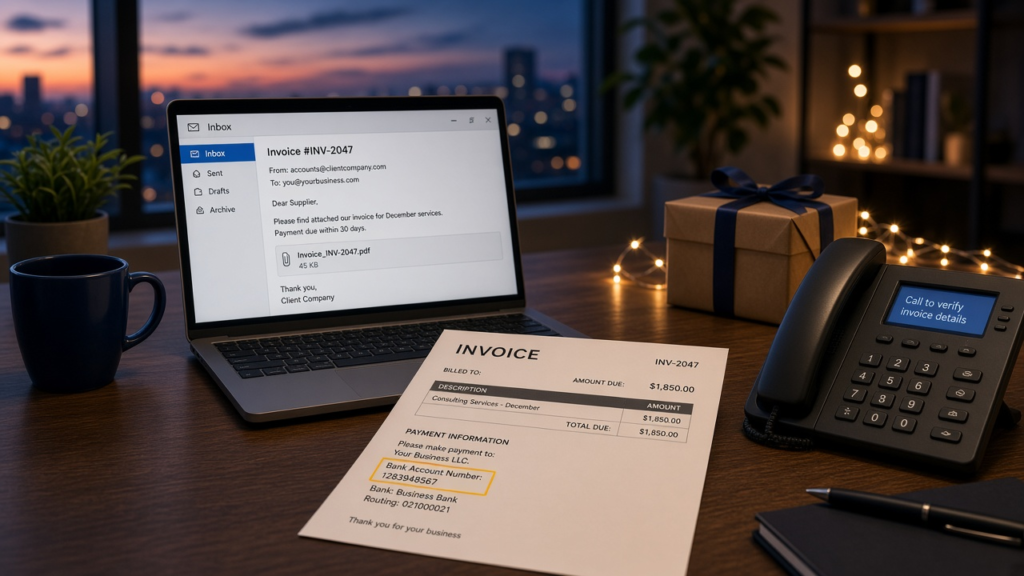
The vendor whose bank “changed.” You get an email from a supplier you’ve paid for years. Same name, same signature, same invoice format. There’s a short note that they’ve switched banks and you should use the new account details going forward. Sometimes it comes from a lookalike address that’s one letter off. Increasingly, it comes from the vendor’s real mailbox, because a criminal broke into it first.
The hijacked conversation. An attacker quietly gets into an email account, on your side or the vendor’s, and watches a real conversation about a real payment. When the timing is right, they reply in the same thread with “updated” wiring instructions. The names, invoice numbers, and history are all genuine, which is why it works.
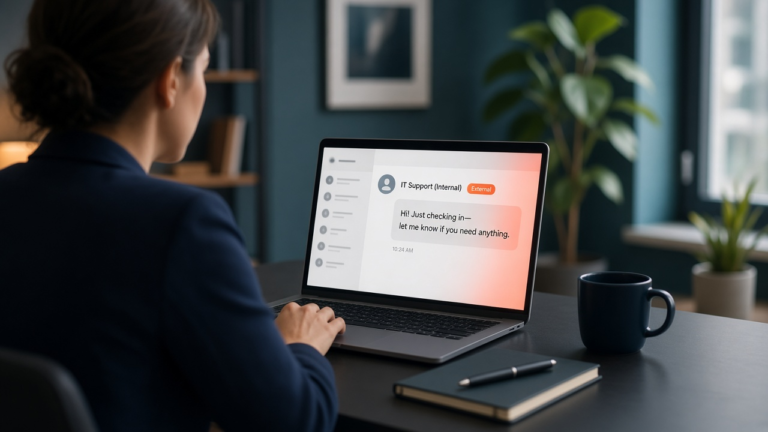
The urgent request from the top. Someone posing as the owner or CFO emails a staff member late in the day: a payment needs to go out before the office closes, it’s confidential, and they can’t take a call right now. The pressure and the secrecy are the point.
There’s also a payroll version: an “employee” emails HR asking to update their direct deposit right before the last pay run of the year.
Why technology alone won’t catch it
Your spam filter and antivirus are built to stop malicious links and files. A polite email asking you to update a vendor’s bank details contains neither. When the message comes from a real, compromised account, it can pass every technical check you have.
That’s why the strongest protection here is a business process, not a product. If your team is already stretched, as we found when we looked at the gap between feeling secure and being secure, a simple rule that everyone follows beats a sophisticated tool nobody has time to manage.
Five things to put in place before December
1. Verify every bank detail change by phone, using a number you already have. Not the number in the email or on the new invoice. Call the vendor at the number in your records and confirm the change with someone you know. Make this a written rule, not a suggestion.
2. Require two people for new payees and changed account details. One person enters the change; a second, separate person approves it. No single person should be able to redirect money based on an email alone.
3. Tell your team, in writing, that urgency doesn’t override the process. Fraud works by making people feel they’ll get in trouble for slowing down. Make it clear that nobody, including the owner, will be upset when someone stops to verify a payment request. Then back that up when it happens.
4. Tighten the email accounts that touch money. Accounting, payroll, and leadership mailboxes deserve the strongest sign-in protection you have, and alerts when someone creates new inbox rules or forwarding, which is often the first sign an account has been taken over. This is a good conversation to have with your IT provider.
5. Decide now who gets called if money goes to the wrong place. If a fraudulent payment goes out, the window to recover it is measured in hours, not days. Know who calls the bank, who contacts your IT provider, and who reports it to the FBI’s Internet Crime Complaint Center. That decision shouldn’t be made for the first time on December 23rd with half the office gone.
The bottom line
Year-end payment fraud doesn’t depend on a technical flaw. It depends on a busy person trusting an email at a busy time of year. The fix is mostly about slowing down the right moments: a phone call before a bank change, a second set of eyes on a new payee, and a team that knows they’re expected to ask.
If you’d like help reviewing your payment approval process or locking down the email accounts that handle money, reach out to the Altivus team. A 20-minute review now is a lot cheaper than an unrecoverable wire in December.