
Article Summary: Cyber insurance pricing is falling, but carriers now verify your controls as of the day an incident happens. What that means for your renewal questionnaire, and where the gaps usually open up.
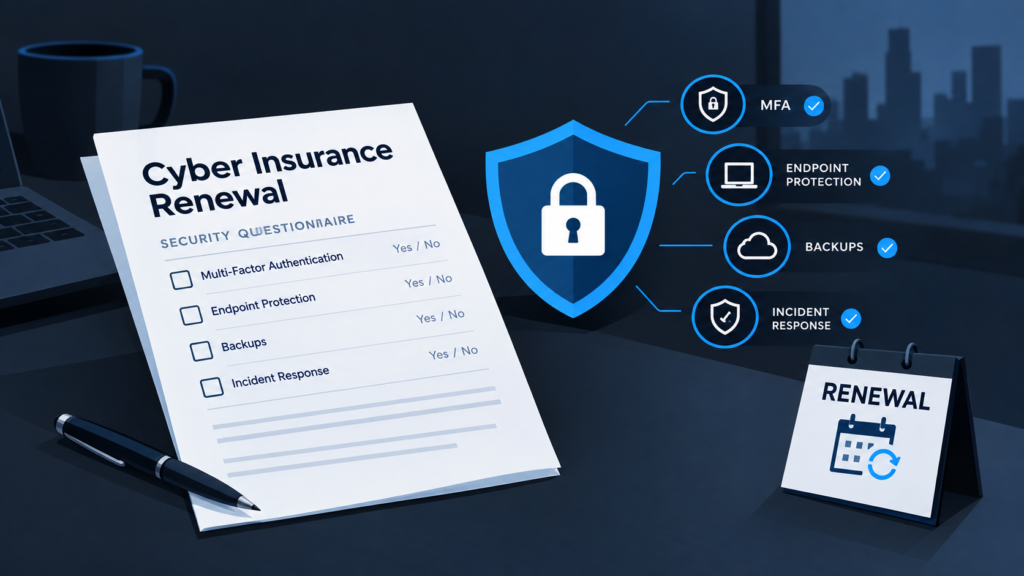
A cyber insurance application usually arrives as paperwork. The questionnaire lands in someone’s inbox — often the owner, the office manager, or whoever handles the books — with a list of yes-or-no questions about multi-factor authentication, endpoint protection, backups, and incident response. Someone fills it out from memory, the broker sends it on, and the policy renews. It feels like a form. It’s closer to a contract.
The market has been sending mixed signals lately. Cyber insurance pricing has actually been getting cheaper. Marsh’s global index recorded another rate decline in the second quarter of 2026, the twelfth quarterly drop in a row, with pricing well below where it sat in 2022. If you only watched the premium line on your renewal, you’d conclude that carriers had relaxed.
They didn’t. They moved the scrutiny from the front end to the back end. Premiums came down; verification at claim time went up.
What a cyber insurance application actually verifies
When you attest on a cyber insurance application that multi-factor authentication is enforced on all remote access, or that endpoint detection is deployed across every device, the carrier isn’t just pricing your policy off that answer. They’re establishing what was supposed to be true if you ever file a claim. After an incident, a forensic investigator reconstructs your environment as it existed that day. If MFA was enforced everywhere except one legacy VPN account nobody remembered, or the detection software was installed on forty-two of forty-seven machines, that difference becomes a coverage conversation.
The industry’s own data shows how often this happens. Roughly a quarter of data breach claims now run into policy exclusions that reduce or eliminate the payout, and disputes increasingly turn on whether multi-factor authentication was genuinely enforced when the breach occurred. That’s not a small margin, and it’s arriving at a point when claims are expensive: Aon’s average ransomware claim nearly doubled between 2024 and 2025, from around $374,000 to $713,000.
The problem is drift, not dishonesty
Almost nobody lies on these forms. What happens is more ordinary. You answer accurately in March. Over the next eleven months, a new laptop gets handed to a new hire and never gets the security agent installed. A vendor needs access and gets an MFA exception “temporarily.” A server gets added and quietly falls outside the backup job. Each of these is a small operational decision made by someone reasonable who was solving a real problem that day.
It’s a little like getting an insurance discount for a sprinkler system and then having someone shut a valve during a renovation. The discount was legitimate when you earned it. It just isn’t what protects you during the fire.
Three questions to answer before your next cyber insurance application
Can you prove it, not just assert it? Carriers increasingly want dated evidence — coverage reports showing which devices actually have protection installed and reporting in, records of MFA enforcement, logs of backup restore tests. The useful discipline here isn’t paperwork for its own sake. If you can’t produce a current list of every device and account in your business, you can’t honestly answer the questionnaire either.
Have your backups been restored, or just run? A backup job that reports success every night is not the same as a backup you’ve proven you can recover from. Insurers have gotten specific about this, and so have attackers, who now routinely go after backups before encrypting anything else.
Who owns this between renewals? This is the question most businesses skip. The application is a snapshot; the policy assumes a moving picture. Someone needs to be responsible for noticing when a new device, a new employee, or a new vendor falls outside the controls you promised to maintain.
The practical takeaway
Treat the cyber insurance application as the security review it actually is. Fill it out from evidence rather than recollection, fix what you find before you submit rather than after a claim, and keep the underlying record current through the year instead of reconstructing it the week the renewal is due.
Most of what carriers are asking for is what you’d want in place anyway. The insurance requirement just puts a date and a dollar figure on the gap between having security tools and having them consistently applied. If you’re not sure which side of that line your business sits on, the time to find out is during renewal — not during an incident.
Not sure whether your controls would hold up to that kind of review? We offer a free Technology Assessment: a high-level review of where your business technology stands, the potential issues we can see, and where improvements could help, followed by a summary report of what we found and our recommendations. Any work afterward is scoped and quoted separately.